Professional Metal Framing Services in Greenwich, CT
NBA Construction & Remodeling installs metal framing in Greenwich commercial spaces, multifamily buildings, and high end residential projects throughout Belle Haven, Backcountry, Old Greenwich, Riverside, and downtown areas. Eighteen years working in Fairfield County means our crew knows when steel stud framing makes sense for Greenwich projects. Light gauge metal framing handles fire rated assemblies, sound walls between Greenwich condominium units, and dimensional stability that wood cannot match. Greenwich Avenue retail buildouts and high end basement renovations in estate homes both benefit from metal stud construction.
Most Greenwich metal framing projects we handle fall into three categories. Commercial buildouts on Greenwich Avenue and along Putnam Avenue where retail and office spaces need fire rated demising walls, sound rated partitions, and code compliant assemblies. Multifamily and condominium work where unit demising walls and fire rated corridors require steel studs to meet code. And high end residential projects in Backcountry and Belle Haven estates where basement renovations, home theaters, and wine cellars use metal framing for moisture resistance and dimensional stability over decades of use.
Greenwich has its own quirks for metal framing work. Coastal humidity along Long Island Sound from Old Greenwich to Belle Haven creates conditions where wood framing fails over time. Steel studs do not warp, twist, or rot in these conditions. Greenwich Avenue commercial buildouts need code compliant fire rating that metal framing delivers naturally. Backcountry and North Greenwich estate basements often have moisture exposure from high water tables and proximity to streams. Metal studs handle these conditions where wood would fail. Our crew has done this work in every Greenwich neighborhood.
Commercial Metal Framing in Greenwich
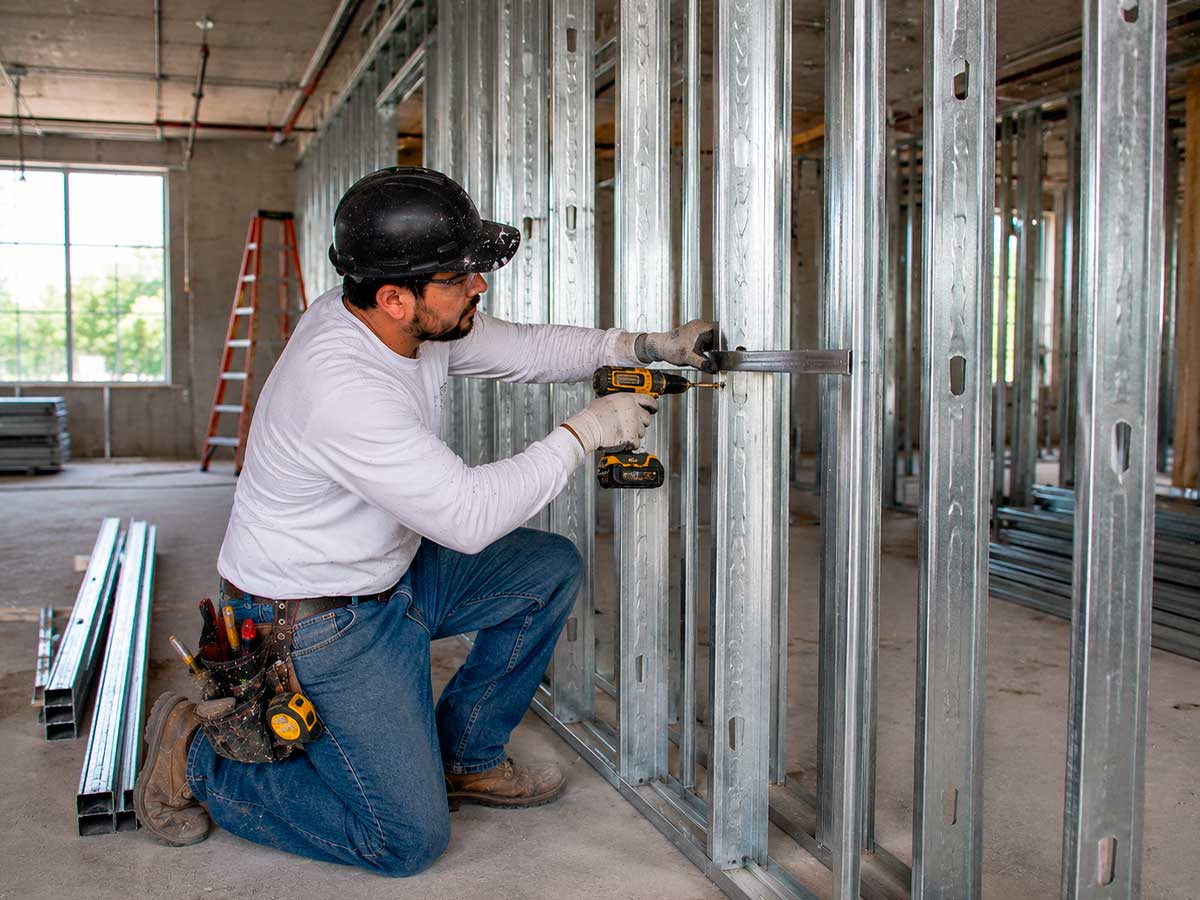
Commercial metal framing in Greenwich starts with the layout and the load. Greenwich Avenue retail spaces, office buildouts in downtown commercial buildings, and restaurant fitouts each have specific requirements. We use 25 gauge steel studs for non load bearing partitions, 20 gauge for taller walls and where the design calls for it, and heavier gauges for walls supporting cabinets, fixtures, or upper floor loads. Track installation comes first with concrete fasteners or shot pin anchors depending on the substrate. Studs install on layout sixteen inches on center for standard partitions, twenty four inches for some areas.
Fire rated assemblies are where Greenwich commercial metal framing earns its place. Greenwich Avenue tenant demising walls between retail spaces require one hour or two hour fire rating depending on building class. We install per UL listed designs with the right gauge studs, proper screw spacing, and fire rated drywall assemblies on both sides. Shaft walls around mechanical chases need specific assemblies. Our crew documents every assembly as we go for the Greenwich Building Department inspection. Cutting corners on commercial fire rating costs the tenant rent on space they cannot occupy until the wall passes inspection.
Sound rated partitions matter in Greenwich commercial work too. Office buildouts between executive spaces, restaurant kitchens adjacent to dining rooms, and conference rooms next to open work areas all need sound transmission ratings to function correctly. Metal framing with proper insulation, resilient channels where needed, and double drywall assemblies achieves the STC ratings the Greenwich design calls for. We work from the architect specs and document the assemblies. Greenwich Avenue retail tenants and downtown office occupants notice the difference between code minimum and properly designed sound walls in occupied space.
Multifamily and Residential Metal Framing
Multifamily metal framing in Greenwich condominiums and apartment buildings requires more code attention than single family work. Unit demising walls between condominium units need fire rating and sound rating both. Fire rated corridors connect units to exit stairs. Shaft walls protect mechanical and electrical chases. Our crew installs per the architect drawings and the UL listed assembly schedules. Greenwich condominium developments along Steamboat Road and downtown require steel framing for the demising walls because of the fire and sound code compliance needed in multifamily occupancy types under Connecticut building code.
Residential metal framing in Greenwich estate homes serves specific purposes. Basement renovations in Backcountry and Belle Haven estates use metal studs because of moisture exposure from high water tables, proximity to streams, and coastal humidity. Wine cellars need stable dimensions that wood cannot maintain over decades of temperature and humidity cycles. Home theaters benefit from metal framing for sound isolation and dimensional stability for the precise speaker placement these spaces require. We install steel studs where the project benefits and wood where wood is the right choice.
Curved walls, soffits, and architectural features in Greenwich high end homes often use metal framing because steel bends and forms in ways wood cannot. Greenwich Backcountry estate great rooms with curved soffit details, cove ceilings in Belle Haven dining rooms, and feature wall assemblies in Old Greenwich modern renovations all benefit from metal stud framing. We layout the curves, cut and shape the studs, and fasten them to the right substrate for the assembly type. The drywall hangs cleaner over metal than over flexed wood, and the finished feature looks the way the Greenwich architect intended.
Why Metal Framing Quality Matters in Greenwich
Greenwich coastal humidity along Long Island Sound from Old Greenwich to Belle Haven destroys wood framing over decades. Steel studs do not warp, twist, or rot in these conditions. Backcountry and North Greenwich estate basements with moisture exposure from streams and high water tables cause wood framing to fail within years. Metal framing handles these Greenwich conditions where wood does not. The difference is not visible the first year, but five and ten years later the metal framed wall holds true while the wood framed wall develops cracks, sticking doors, and moldings that pull away from finished surfaces.
Code compliance in Greenwich commercial and multifamily work demands metal framing in many assemblies. Connecticut building code requires fire rated demising walls between Greenwich Avenue retail tenants. Multifamily condominium projects need fire and sound rated unit demising walls. Shaft walls around mechanical chases require specific UL listed assemblies. We install metal framing per these code requirements and document the work for the Greenwich Building Department inspector. Code compliant work passes inspection the first time and protects the building owner from liability for the life of the property.
Cost matters in Greenwich but cheap metal framing always costs more in the long run. Wrong gauge studs flex under load and cause drywall cracks within months. Improper fastener spacing fails fire rating tests and forces redo work. Skipped insulation in sound rated walls means tenant complaints in Greenwich condominium and office work. Doing it right the first time is cheaper than doing it twice. That is why we charge what we charge and why our Greenwich commercial clients, building managers, and high end residential homeowners keep calling us back for the next metal framing project they need.